



Our Work

Civis Public Consultation Awards

View Award Categories
The Civis Public Consultation Awards (CIPCA) recognise exemplary consultation practices within government and help establish benchmarks for stronger public consultation.
The effort to spotlight good consultation practices is to improve the standard quality, credibility, and effectiveness of these processes. By encouraging ministries, departments, regulators, and state governments to integrate consultation more meaningfully into policymaking, the Awards contribute to a shift from procedural compliance to more inclusive, efficient, and citizen-responsive governance.
Impact

Creating a Ripple Effect

While encouraging more ministries, departments and state-level governments to inculcate public consultations in their law-making process, the Awards have also nudged for furthering the quality and efficiency of consultations conducted.
Volume of Consultations
+2100%
Growth since 2014 in total number of consultations per year
288
Consultations assessed in 2025 Awards
vs
175
Consultations assessed in 2024 Awards
+35.7%
Increase in adoption of public consultations across states and union territories
Transparency & Responsiveness
+40%
Of consultations in 2025 published a summary of responses, as compared to just 10% in 2014-15.
Quality of Documentation
100%
Consultations are now conducted with clearer, structured documents through more drafts with impact assessments & explanatory notes
Duration
+42.8%
longer public feedback windows are now provided for consultations (from 2024 to 2025).
Inclusivity & Accessibility
+71.4%
Increase in the number of consultations published in more than one language.
Decorative gold floral and paisley patternDecorative gold floral and paisley pattern
Attendees

The Minds Behind the Awards

Jury

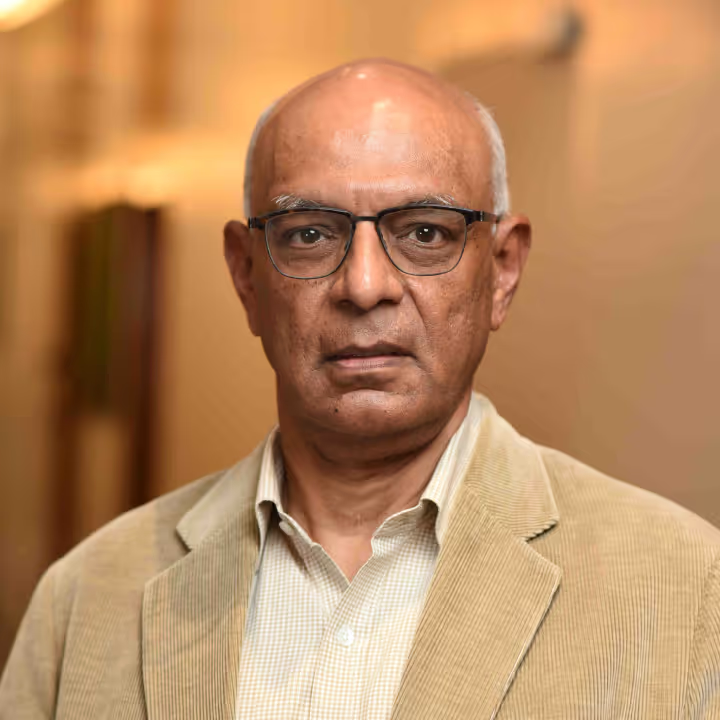
jury member headshot
Mr. G.N.
Bajpai
Former Chairperson, Securities & Exchange Board of India (SEBI)
Former SEBI and LIC chairman known for financial regulation and corporate governance.
jury member headshot
Dr. Sekhar
Bonu
Former Director General, Monitoring and Evaluation Office (DMEO), NITI Aayog
Former NITI Aayog leader focused on governance, state capacity, and development policy.
jury member headshot
Dr. M.S
Sahoo
Founding Chairperson, Insolvency & Bankruptcy, Board of India (IBBI)
Regulatory reform expert leading insolvency, securities market, and governance transformation initiatives.
jury member headshot
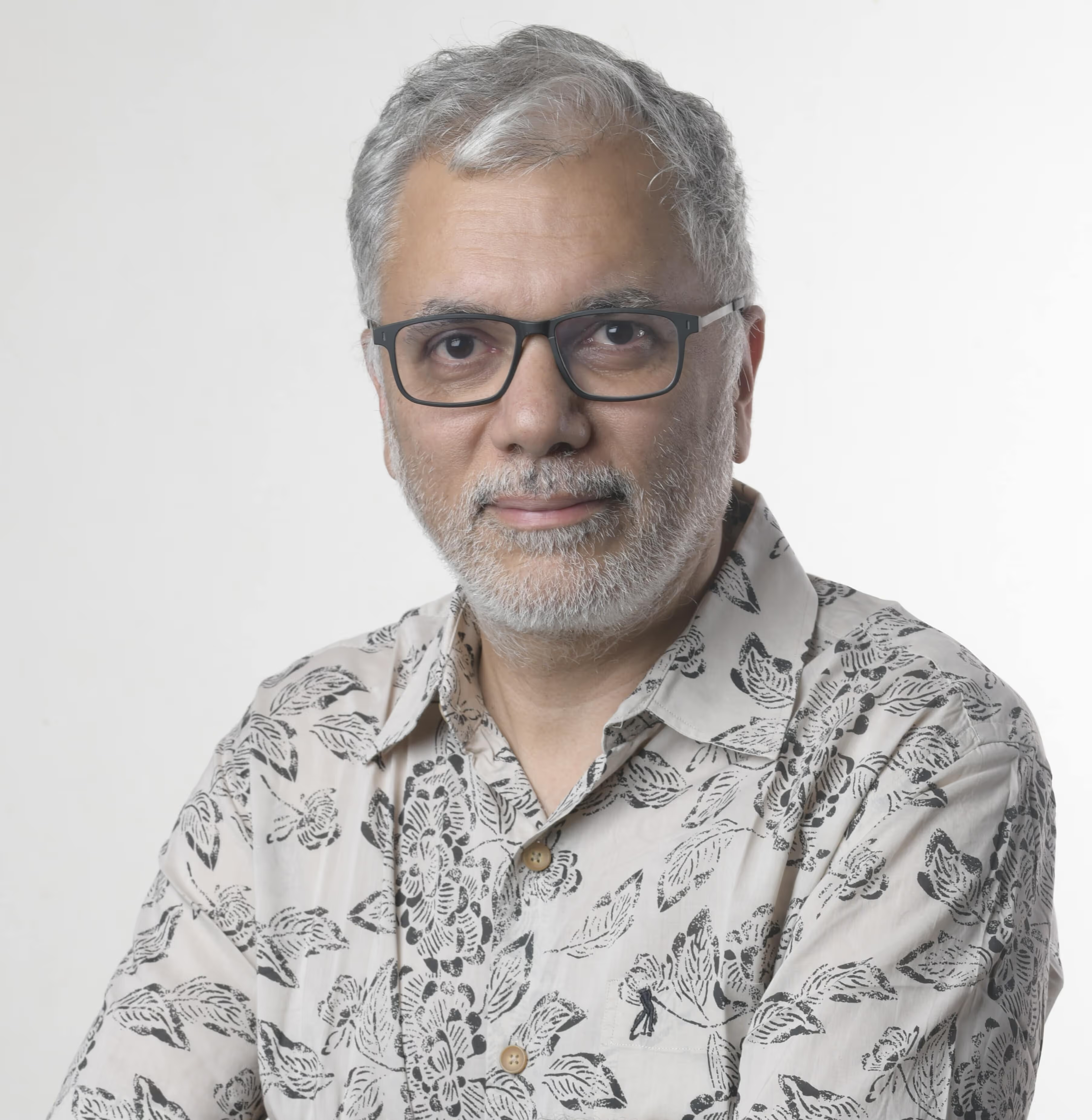
Dr. Ajay
Shah
Co-founder, XKDR Forum, & Founder & Chief Editor – LEAP Blog
Economist and policy scholar focused on governance, finance, and economic reforms.
jury member headshot
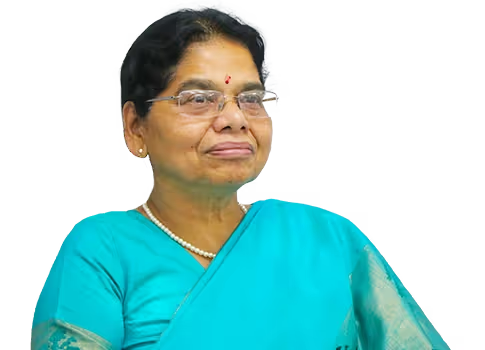
Smt. Snehlata
Shrivastava
Former Secretary General, Lok Sabha
Former Lok Sabha Secretary-General and IAS officer with leadership across justice, finance, and governance.

Keynote Speakers & Panelists

Keynote Speakers & Panelists headshot
Mr. G.N.
Bajpai
Former Chairperson, Securities & Exchange Board of India (SEBI)
Former SEBI and LIC chairman known for financial regulation and corporate governance.
Keynote Speakers & Panelists headshot
Dr. R
Balasubramaniam
Member-Human Resource, Capacity Building Commission of India
Founder of SVYM and GRAAM, leadership scholar, Cornell academic, public policy advocate
Keynote Speakers & Panelists headshot
Dr. Parth
J. Shah
President,Centre for Civil Society
ISPP and CCS founder focused on governance reform and policy education.
Keynote Speakers & Panelists headshot
Dr. KP
Krishnan
Former Secretary, Ministry of Skill Development and Entrepreneurship
Former IAS officer and policy expert specialising in governance, regulation, and economic reform.
Keynote Speakers & Panelists headshot
Shri P.K.
Malhotra
Former Law Secretary, Government of India
SAT member, Law Commission expert, Delhi University gold medalist in international law.
Keynote Speakers & Panelists headshot
Dr. Deepak
Mohanty
Chairperson, PFRDA
Former RBI Executive Director, IMF advisor, and economist with extensive policy experience.
Keynote Speakers & Panelists headshot
Dr. M.S
Sahoo
Founding Chairperson, Insolvency & Bankruptcy, Board of India (IBBI)
Regulatory reform expert leading insolvency, securities market, and governance transformation initiatives.
Keynote Speakers & Panelists headshot
Mr. Abhishek
Singh
Additional Secretary at the Ministry of Electronics and Information Technology
Digital India leader driving AI, governance innovation, and civil service capacity building.
Keynote Speakers & Panelists headshot
Mr. Adil
Zainulbhai
Former Chairperson, Capacity Building Commission
Former McKinsey India chairman, IIT Ropar board chair, and Quality Council of India leader.
Decorative gold floral and paisley pattern
A suited professional meeting with a client across a desk in a formal office.
ObJective

Strengthening democracy through public consultation

First launched in 2024 to mark ten years of the Pre-Legislative Consultation Policy (PLCP) introduced in 2014, the CIPCA Awards serve as a norm-setting initiative that benchmarks what good consultation can look like.

Through the recognition of standout bodies, it has helped drive improvements in the quality and efficiency of consultations.

The objective is twofold: to highlight best practices in public consultation and to encourage wider adoption of inclusive and transparent lawmaking processes.

By codifying and celebrating outstanding efforts, the awards serve as both recognition and inspiration, showcasing how participatory governance can strengthen democracy and improve the quality of policy outcomes.

Award Categories

Best Consultation - Ministry

This category recognises exemplary consultations conducted by Union Ministries. It highlights cases where ministries have gone beyond procedural compliance to embrace openness, inclusivity, and responsiveness in the policymaking process. Winning consultations in this category set benchmarks for how central policies can be shaped with citizen voice at their core.


Best Consultation - State

Best Consultation - Statutory Body

Special Mention CIPCA 2024 & 2025 - Responsive Governance

Special Mention CIPCA 2024 – Sustained Excellence

Special Mention CIPCA 2025 - Citizen-Government Engagement

Special Mention - Volume of Consultation

Decorative gold floral and paisley pattern Decorative gold floral and paisley pattern

Methodology

The awards are grounded in a rigorous framework combining global best practices with India’s democratic traditions. Civis developed 10 evaluation parameters, drawing on the Pre-legislative Consultation Policy 2014, the OECD’s Practitioners’ Guide for Engaging Stakeholders, and UNDP’s Public Consultation Index, refined over two editions with expert jury input.
PILLAR 1

Quality of the Consultation Document

A consultation document forms the starting point for public participation. This pillar assesses whether it equips stakeholders to engage meaningfully by evaluating clarity, justification, broader implications, and the accessibility of the language.
Justification
Clarity of the need for policy change.
Essential Elements
Completeness of proposed provisions
Impact Assessment
Financial, social, and environmental implications.
Comprehension
Accessibility of language and structure
PILLAR 2

Scope of Engagement and Opportunities

Publishing a draft alone doesn’t ensure meaningful consultation. This pillar assesses whether stakeholders had adequate opportunity, time, and awareness to engage, and whether they made genuine efforts to reach affected audiences.
Duration
Adequacy of consultation period.
Outreach
Scope and diversity of communication channels.
PILLAR 3

Inclusivity

Consultations are most effective when participation reflects the diversity of affected communities. This pillar assesses whether the consultation design reduced barriers to participation and expanded access for different audiences.
Feedback Collection
Multiple, accessible methods for responses.
Translations
Regional languages and accessible formats
PILLAR 4

Open Governance

Public participation builds trust when stakeholders can see how their input shapes decisions. This pillar assesses whether institutions demonstrate transparency and accountability in acknowledging, disclosing, and acting on feedback.
Transparency
Publishing feedback summaries and next steps.
Responsiveness
Engagement with citizen queries and RTIs.